
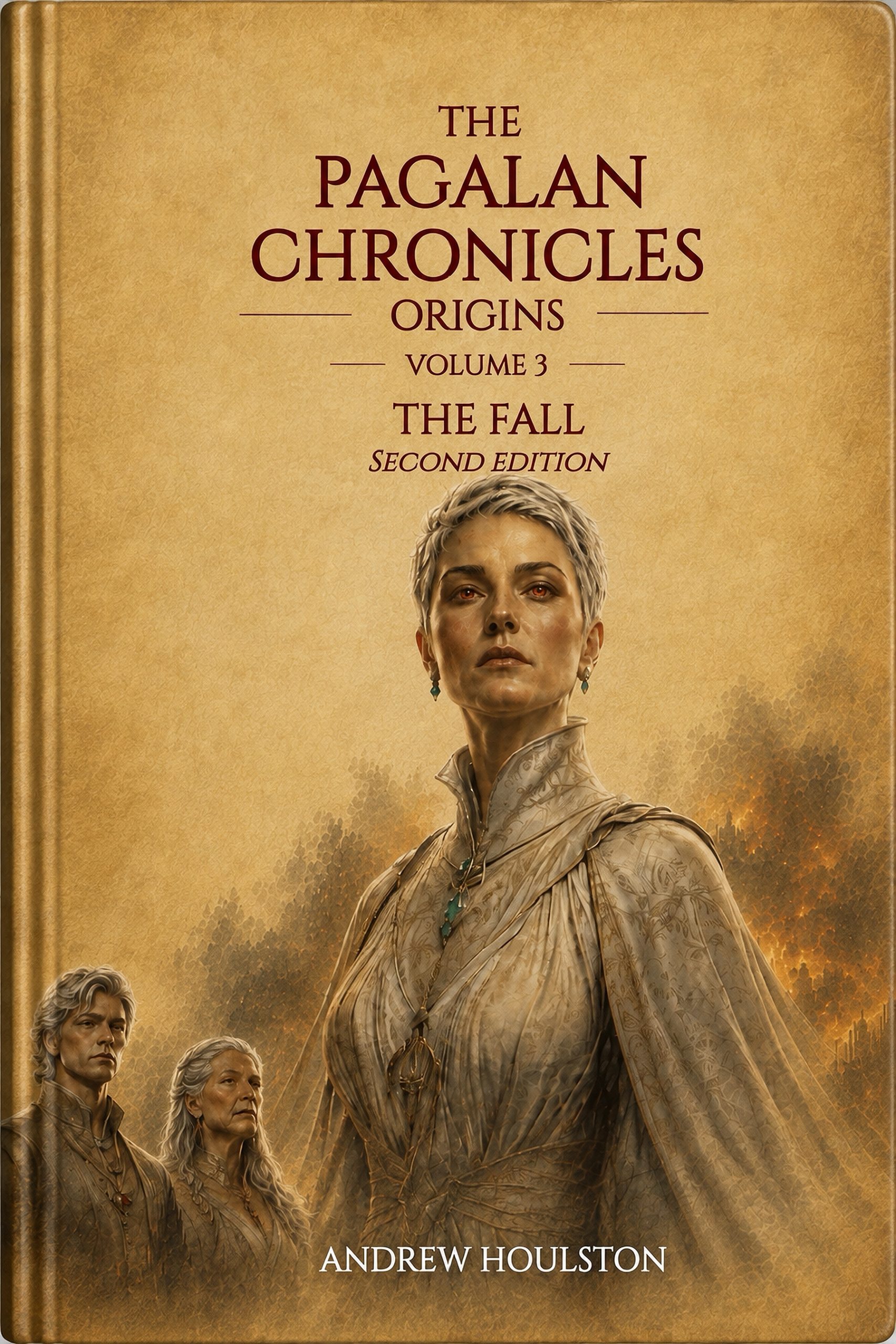
The Pagalan Chronicles Origins – Volume 3
The Fall
Spoiler Alert: This summary reveals plot details that some readers may prefer not to know in advance.
Nine hundred years had passed since the Patronese first arrived on Pagalan.
The refugees who had once crawled from ancient Obelisks onto the frozen shores of Denesthear had become the masters of one of the most sophisticated civilisations the world had ever known. Tramstell gleamed beneath the sky, its great towers joined by luminous avenues, its cities connected by advanced transport systems and its society sustained by technologies that had once seemed miraculous even to the first settlers.
The Patronese had survived.
They had expanded.
They had prospered.
And they had forgotten how fragile everything was.
Beneath the ordered beauty of Denesthear, the divisions first glimpsed in The Arrival and hardened in Establishment had never truly disappeared. The distinction between High Order and Low Order remained woven into the structure of society. The ancient gates had been sealed. Knowledge had been restricted. Resonance technology had become something the ruling Council controlled rather than something the people collectively understood.
The Patronese believed the danger had passed.
Olivier Martelismore knew otherwise.
Thirty-five years old, reserved by nature and carrying the combined legacy of the Telismore, Camberlain and Martelismore bloodlines, Olivier had inherited far more than a famous name.
Around her neck hung the ancient green gem.
It had passed through generations from the earliest days of the Patronese settlement and had become little more than a historical relic in the eyes of most people.
But the gem had begun to wake.
So had Denesthear.
The resonance network beneath Tramstell was failing.
Conduits burned themselves out without explanation. Whole districts suffered unexplained power losses. Strange pulses travelled through systems that had operated reliably for centuries. Low Order workers, already angry at generations of inequality, became increasingly restless as the failures spread.
Beyond Denesthear’s northern boundaries, the news was more disturbing still.
Communities once regarded as primitive had begun displaying technologies they should not have possessed. Strange weapons appeared. Unidentified craft were reported moving through the northern skies. Energy signatures resembled the forbidden resonance systems of the Patronese.
Someone had taught them.
Or something had.
Olivier brought the evidence before the High Council.
They dismissed her.
To them, Denesthear still stood. Tramstell’s towers still shone. The barriers remained intact. The gates had been closed for generations.
Why should the Council abandon stability because one councillor believed she could hear danger approaching?
Olivier’s answer was simple.
Because the foundations were already cracking.
She warned that the disturbances within Tramstell and the activity beyond its borders were connected. The northern peoples were not merely advancing technologically. Something was feeding power into the resonance lattice itself.
The Council refused to sanction an investigation.
So Olivier decided to go without them.
Her closest friend, Jasmine Crelthorp, helped her escape the surveillance of Tramstell. Jasmine had a life Olivier had long believed she herself would never know, a husband, Daniel, a young son, Logan, and the warmth of a family home that stood in sharp contrast to Olivier’s solitary existence.
Their friendship gave Olivier something the Council never had.
Trust.
Using an old craft and forgotten routes beneath Tramstell, Olivier crossed the outer barrier.
What she discovered beyond it destroyed any hope that the disturbances were merely mechanical.
The northern resonance field was active.
Within it she encountered figures that resembled no ordinary people of Pagalan. Tall, unnaturally thin beings moved through the green light, their dark forms and strange features intertwined with technologies that carried unmistakable traces of Benefactor design.
These were not simply tribes who had rediscovered ancient machines.
Something else had entered the equation.
Something that understood resonance.
Something that had learned to use it.
Olivier barely escaped.
When she returned to Tramstell, she brought proof of a threat that should have forced the Council to act.
Instead, the city seemed to recover.
The power fluctuations stopped.
The resonance settled.
The lights returned to perfect synchronisation.
Tramstell appeared healed.
Olivier trusted the calm even less than the chaos.
She understood that silence did not necessarily mean absence.
Sometimes silence meant that something was listening.
Her investigations carried her deeper into the neglected regions beneath Tramstell, where Low Order workers maintained the conduits that kept the gleaming upper city alive. There she discovered another Denesthear entirely.
The Council chambers spoke endlessly about stability.
The lower levels lived with its cost.
Workers laboured beside failing machinery. Resentment passed quietly through corridors ignored by the High Order. Rumours spread of voices within the resonance network, of strange dreams, of systems activating without instruction.
The city itself seemed to be responding to the anger within it.
Olivier began to wonder whether the resonance was merely energy at all.
Perhaps it was reactive.
Perhaps it remembered.
Perhaps, in some incomprehensible way, it was alive.
Her questions made her increasingly dangerous to those who wanted the established order preserved.
Surveillance tightened.
Access was restricted.
The Council attempted to contain her activities.
But Olivier had already begun building a network of people willing to search for the truth.
The trail led west.
In Sostrem, another supposedly dormant gate complex had begun showing the same symptoms. With the help of Merren Voltren, an engineer whose scepticism slowly gave way to fascination, Olivier entered the abandoned gate chambers.
The system activated when she approached.
The green gem responded.
Light gathered inside the gate.
And within that light appeared the same beings she had seen in the north.
The revelation was chilling.
The phenomenon was not local.
The entire resonance network was being awakened.
The creatures were somehow using the ancient structures as a pathway.
Worse still, the gate appeared aware of Olivier.
Her bloodline mattered.
The gem mattered.
And something within the lattice recognised the name Telismore.
The deeper Olivier travelled into Denesthear, the more the failures spread.
At Cradlmont, the awakening became catastrophic. Resonance surged through towers and conduits until the city threatened to tear itself apart.
Olivier succeeded in stabilising the immediate crisis, but by then the Council could no longer dismiss what was happening.
She had brought the proof they demanded.
It was terrifying enough to force them to listen.
The Council restored Olivier’s authority and commissioned a major expedition to the north.
Their vessel was the Trine Veil.
It was among the most advanced craft the Patronese had ever created, a vast armoured ship combining Patronese engineering with technologies derived from the Benefactor legacy.
For Olivier, it represented both hope and warning.
The Patronese had once promised never to become dependent upon powers they did not fully understand.
Nine centuries later, one of their most sophisticated vessels relied upon precisely such technology.
Merren joined her.
What had begun as professional cooperation grew into something more personal. For a woman who had spent much of her life believing that solitude was inevitable, Merren’s presence became increasingly important.
He did not worship her bloodline.
He did not fear her questions.
He simply stood beside her.
Together they travelled north.
The polar regions did not behave like the rest of Pagalan.
Auroras moved in deliberate patterns.
Storms responded to the ship’s resonance field.
Light twisted around invisible structures.
The Trine Veil entered a region where the boundary between machinery, environment and something far stranger had become impossible to define.
Then the ground opened beneath them.
Olivier and Merren were drawn into a buried complex beneath the ice.
What waited below was older than Tramstell.
Older than Patronese settlement.
Perhaps older than the history of Pagalan as the Patronese understood it.
The structure combined Benefactor technology with something alien.
Black stone flowed with green light. Walls appeared almost organic. Symbols belonged partly to the Benefactors and partly to another civilisation entirely.
Evidence of violence remained.
Ancient machines lay abandoned.
Preserved remains suggested that the Benefactors themselves had once fought to contain whatever had existed there.
Olivier had spent her life believing that the Benefactors represented an almost godlike pinnacle of knowledge.
Now she discovered they too had been afraid.
And they had failed.
As Olivier and Merren travelled deeper, they encountered echoes of those who had come before.
The complex did not merely preserve information.
It preserved memory.
Voices moved through it.
Images of the past appeared around them.
Time itself seemed layered inside the structure.
At the centre lay something Olivier came to understand as a Source, a vast living nexus of resonance.
There the boundaries of her understanding collapsed completely.
The resonance did not appear to have begun with the Patronese.
Nor did it simply belong to the Benefactors.
It reached further back.
Pagalan itself seemed connected to it at the deepest level.
The Patronese had not merely stumbled upon Benefactor technology after arriving on the planet.
Their affinity with resonance may have been one of the reasons they had been drawn to Pagalan in the first place.
The ancient systems recognised them because there was already something within them capable of answering.
For centuries the Patronese had interpreted stronger resonance sensitivity as proof that certain bloodlines deserved higher status.
Olivier saw a different truth.
The resonance did not recognise political rank.
It recognised connection.
The distinction between High and Low Order had therefore been built not upon divine entitlement but upon a human interpretation of something vastly more complex.
And the system itself had become unstable.
Something had crossed into the resonance.
Something was attempting to use its memory.
Time began to fracture.
Olivier and Merren returned towards the Trine Veil believing they had been beneath the ice for only hours.
The world around them suggested otherwise.
Structures had aged.
Snow had accumulated where none should have been.
The ship itself seemed to have existed through a period they had never experienced.
Time had not passed normally within the Source.
The threat was no longer simply invasion.
Reality itself was becoming unstable.
Signals spread from twelve dark spires across the north. Communications failed across Denesthear. The resonance lattice appeared to be rewriting connections between places, memories and moments.
Olivier reached a terrifying conclusion.
The only way to prevent the collapse might be to change what had already happened.
Doing so could destroy the version of history in which she currently existed.
Merren understood the cost.
So did Olivier.
No Council would remember the decision.
No monument would commemorate what she was about to do.
The people she saved might never know they had needed saving.
Olivier returned to the Source.
There, surrounded by reflections of lives and possibilities, she chose balance.
She allowed herself to merge with the field.
The world folded.
The timeline changed.
And Olivier vanished into light.
Then she woke in her own bed.
Morning sunlight streamed through the windows of Tramstell.
The city was intact.
The terrible expedition seemed to have been nothing more than an unusually vivid dream.
Merren Voltren was a man she somehow felt she knew despite having no reason to know him.
Events she remembered had never happened.
Places she had visited carried no record of her presence.
The catastrophic northern breach had disappeared from history.
Olivier had succeeded.
But not completely.
The green gem still responded.
Reflections sometimes seemed to move incorrectly.
Fragments of memory remained where they should not.
The world had been rewritten.
Olivier carried echoes of the world that had been erased.
And the resonance remembered too.
In this altered history, the crisis unfolded differently.
The ancient power did not return in precisely the same form. Instead, the hidden weaknesses within Patronese civilisation became increasingly visible.
Low Order unrest grew.
The Council continued attempting to suppress information.
Reports emerged of strange harmonic behaviour among children.
Young Patronese began dreaming the same dreams.
They moved in synchronised patterns.
They heard tones no adults could hear.
The development carried a disturbing resemblance to the resonant children of the first settlement, the very children whose differences had eventually contributed to the creation of High and Low Order.
History seemed to be circling towards the same division again.
But this time Olivier was there.
Jasmine became personally caught in the awakening.
Pregnant with another child, she began sensing the resonance with growing intensity. The unborn baby appeared capable of responding to the pulse running beneath the city.
Other children did the same.
The Council reacted with fear.
Experiments began.
Information was suppressed.
Children were treated as a problem to be studied rather than people to be protected.
Olivier recognised the pattern immediately.
The Patronese were once again attempting to control something because they were frightened of listening to it.
She refused to allow history to repeat itself.
The struggle became political as much as technological.
Olivier exposed the Council’s activities.
Evidence of the experiments spread through Tramstell.
Citizens gathered in the plazas demanding answers.
Truth for the children.
End the silence.
The same civilisation that had once regarded order as its greatest virtue was forced to confront what generations of secrecy had produced.
Even Selian, the High Councillor who had repeatedly resisted Olivier’s warnings, eventually admitted the truth.
Her actions had not begun in cruelty.
The Sub-Harmonic systems sustaining Denesthear had been slowly failing. She believed the resonant children might provide a way to preserve the network.
She had wanted to save the civilisation.
But, as Olivier told her, she had forgotten the people the civilisation existed to save.
That distinction changed everything.
Selian stepped down.
And Olivier Martelismore, the quiet woman who had spent so much of her life doubting whether anyone would listen to her, became High Chair of the Denesthear Council.
She did not use the position to strengthen the old hierarchy.
She began dismantling it.
The resonance would no longer belong to one Order or one privileged bloodline.
No child would be treated as property of the state because of an unusual ability.
Knowledge would no longer be sealed simply because it threatened established authority.
High and Low Order would have to become one people again.
For a time, it seemed that Denesthear had finally learned.
The resonance softened.
Tramstell began to heal.
Jasmine gave birth to a daughter, Alenya, a child who seemed to possess her own gentle sensitivity to the world beneath the city.
Olivier watched her friend’s family and saw something she had once believed impossible for herself.
A future.
Her relationship with Merren had deepened through danger, uncertainty and trust.
Eventually they married.
The celebration marked more than their union.
It symbolised the beginning of a different Patronese age.
Olivier, once convinced that her bloodline would end with her, finally allowed herself to imagine children of her own.
The Martelismore line continued.
And for many years, peace endured.
But The Fall was never merely the story of Olivier Martelismore.
It was the story of what happened when lessons survived in memory but faded through generations.
Eighty years later, Olivier had become history.
Her great-grandson, Tharen Sol Martelismore, lived within a Denesthear transformed by the reforms she had begun. High and Low Orders coexisted with far less division. The cities prospered. The terrible resonance crises of Olivier’s youth had become archival material.Her descendants knew the stories.But stories were not the same as experience.
Tharen belonged to a civilisation growing comfortable again.
His mother, Siren Valien Martelismore, stood among its most powerful leaders. Cautious, disciplined and deeply conscious of everything the Patronese had once suffered, she believed stability depended upon keeping old dangers contained.
Then signals returned from the north and the equatorial regions.
The source lay in Verenteer.
The Verentians had changed.What had once been a civilisation outside the Patronese order had gained access to Benefactor remnants.
They had learned to manipulate ancient technologies.
They had reconstructed systems connected to the old projected gates.
And they had begun listening to the same resonance the Patronese believed they had contained.
Tharen recognised the pattern.
He searched the archives.
There he found Olivier’s old warnings.
Fragments of her Trine Veil recordings survived.
Her voice reached across generations.
She had warned that resonance could choose new interpreters.
She had warned that it remembered.
She had warned that attempts to possess it would eventually fail.
The Verentians were no longer simply using Benefactor machinery.
They appeared to be forming their own relationship with the resonance.
The centre of power was shifting.
Tharen begged the Council to understand what this meant.
Siren hesitated.
To her, Olivier’s history was a warning about uncontrolled technology.
To Tharen, it was a warning about refusing to listen until fear made every decision.Once again, two generations looked at the same past and learned different lessons.
The Verentians armed themselves.
Their commander, Rendhal, transformed scattered forces into a military power capable of challenging Denesthear.
Ancient transmitter towers awakened.
Weapons based upon recovered Benefactor principles appeared.Great plasma pulse lances were constructed.
The Patronese responded in kind.
Armies gathered.
Defensive barriers strengthened.
Weapons hidden for generations were reactivated.
A civilisation that had spent decades praising Olivier for choosing restraint began preparing for total war.
Tharen watched the pattern repeat with terrible clarity.
Both sides believed they were defending themselves.
Both sides believed the other was forcing their hand.
Both sides possessed technologies no civilisation should have used lightly.
And neither side was willing to appear weak.
The Verentians advanced.
The Patronese barrier held.
Powerful plasma weapons struck it again and again.
The sky burned with emerald and white energy.
Siren prepared increasingly devastating responses.
Beneath Tramstell, long-sealed armouries opened.
Weapons created for wars everyone had sworn never to repeat returned to readiness.
Tharen searched desperately for another way.
Deep within the old resonance systems, he attempted to influence the harmonic network itself, to prevent the conflict from reaching its inevitable conclusion.
For a moment, it worked.
Inevitability fractured.
The resonance ceased behaving as though war were the only possible outcome.
But human fear had already gathered too much momentum.
The Verentians breached the barrier.
The Patronese responded.
Ancient strategic weapons were unleashed.
What followed was not victory.
It was annihilation.
The sky over Pagalan burned.
Cities vanished beneath fire.
Atmospheric systems collapsed.
Ash filled the heavens.
Oceans were poisoned.
The climate began to fail.
Verenteer was devastated.
And Denesthear, despite all its technology and all its confidence, faced the same truth the Patronese had confronted on Yath Varnel almost a thousand years earlier.
The surface could no longer sustain them.
The people descended.
Tramstell’s gleaming upper terraces were abandoned.
The Patronese retreated into maintenance levels, ancient subterranean chambers and forgotten vaults never intended to house an entire civilisation.
Children who had grown beneath open skies were taken underground.
Families carried what possessions they could.
The great surface cities fell silent beneath ash.
The people told themselves the withdrawal would be temporary.
A precaution.
They could wait until the atmosphere recovered.
They could return when the poisons dispersed.
They could restore what had been lost.
But months became years.
Years would become generations.
And generations would become millennia.
The civilisation that had arrived on Pagalan seeking a second chance had finally buried itself beneath the world it had once hoped to call home.
That was the Fall.
Yet the true tragedy was not that the Patronese lacked warnings.
They had warnings everywhere.
Jentry Camberlain had warned that their new civilisation must not repeat the mistakes that destroyed Yath Varnel.
Jason Telismore had warned that secrecy and hierarchy would poison Tramstell from within.
Domonic Martelismore had warned that the gates should remain closed when power exceeded wisdom.
Olivier had warned that silence was not safety.
Tharen had warned that fear was driving both sides towards a war neither could survive.
The Patronese remembered every warning.
They simply stopped feeling its urgency.
That became the central tragedy of The Fall.
Civilisations did not always collapse because knowledge disappeared.
Sometimes they collapsed because knowledge became history.
The words remained.
The monuments remained.
The archives remained.
But the emotional memory of why those warnings mattered slowly faded.
Each generation inherited the consequences without fully inheriting the fear that had created them.
Olivier stood at the heart of that tragedy because she had come closer than almost anyone to breaking the cycle.
She challenged the Council when silence was easier.
She crossed the barrier when others remained comfortable behind it.
She confronted an intelligence older than Patronese civilisation.
She sacrificed one version of her own life to prevent reality from collapsing.
She defended children the Council wanted to control.
She helped dismantle the division between High and Low Order.
She found love when she had accepted loneliness.
She became a leader despite never seeking power.
And she left her descendants a Denesthear more peaceful than the one she inherited.
For decades, it worked.
But no reform could permanently protect future generations from making their own choices.
No ancestor, however wise, could reach endlessly through time and force descendants to listen.
The Patronese had escaped a dying world.
They had built another civilisation.
They had discovered ancient power.
They had survived internal division.
They had rewritten history itself.
Yet in the end, they remained capable of the most human mistake of all.
Fear.
The Pagalan Chronicles Origins Volume 3: The Fall therefore completed the first great historical arc of the Patronese.
The Arrival had told how they escaped extinction and reached Pagalan.
Establishment had shown how survival became civilisation, and how civilisation began turning knowledge into hierarchy and control.
The Fall revealed the ultimate cost.
It showed how a society could become so advanced that it mistook technological mastery for security.
How political order could disguise internal decay.
How attempts to suppress danger could make that danger harder to understand.
How ancient technology could become mythology, mythology could become authority, and authority could become fear.
And it showed how even a civilisation given a second chance could eventually repeat the errors of the world it had fled.
Yet the story did not end with extinction.
Six months after the firestorm, Tramstell still lived.
Not above ground.
Below it.
The resonance continued humming through the buried chambers.
The ancient systems endured.
The green gem survived through the Martelismore line.
So did memory.
The Patronese had fallen from the surface, but they had not disappeared.
They would remain beneath Pagalan for another two thousand years.
Their descendants would build cities under stone.
Their history would become legend.
The surface would slowly recover.
Other peoples would rise.
The name Denesthear would fade from the knowledge of the wider world.
And one day, generations later, another Martelismore ruler would stand beneath those ancient vaults and ask whether the time had finally come for his people to return to the sky.
His name would be Mandrake Martelismore.
That story would become The King Beneath the World.
But before there could be a king beneath the world, there first had to be a world above him that had been lost.
The Fall tells how that loss happened.
It is the story of a civilisation that possessed almost everything except the ability to escape its own history.
And of one woman who heard the warning before anyone else.
Olivier Martelismore had tried to teach Denesthear to listen.
For a time, it did.
Then the silence returned.