
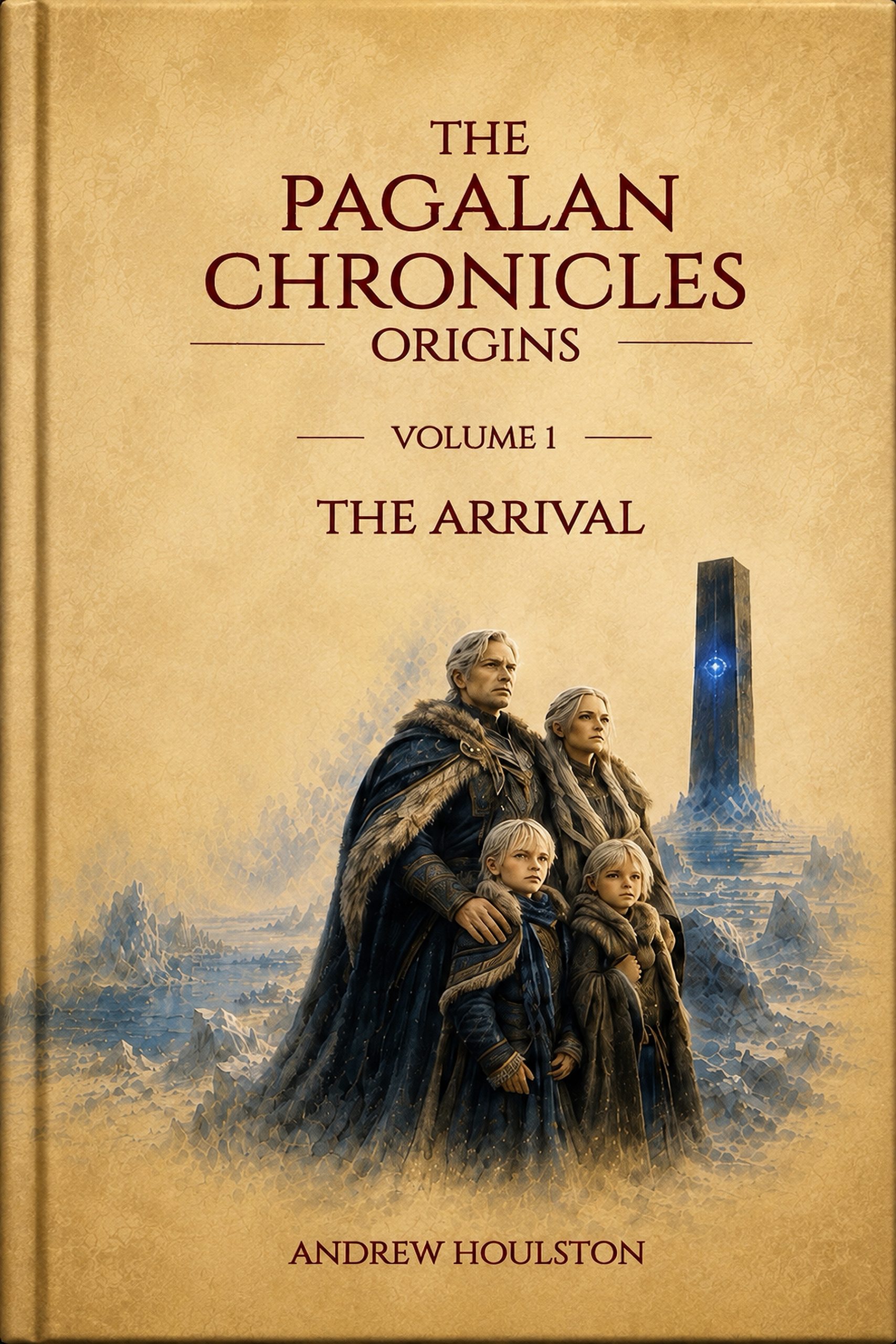
The Pagalan Chronicles Origins – Volume 1
The Arrival
Spoiler Alert: This summary reveals plot details that some readers may prefer not to know in advance.
Before Morganuke Beldere.
Before Denesthear became a lost homeland.
Before the emerald sword, the Optogleans, the hidden cities and the ancient gateways became legends whispered across Pagalan, there had been the Arrival.
And before Pagalan, there had been a dying world.
The Patronese had once called their home Yath Varnel, the Bright Nest, a world of extraordinary knowledge and beauty. Its people had mastered sciences beyond the understanding of most later civilisations, preserved immense archives of knowledge and learned to work with technologies left behind by an even older and more mysterious race.
But greatness had not been enough to prevent extinction.
Yath Varnel was dying.
Its oceans had become stagnant. Its forests of glassleaf and silver root had withered. Ash darkened skies once illuminated by magnificent auroras, and the cracked moon hung above a civilisation that had finally exhausted its ability to survive the world beneath it.
The Patronese knew the end was coming.
What they did not know was whether they could escape it.
Their last Sovereign, Jentry Camberlain, refused to allow his people to vanish with their home world. Intelligent, determined and burdened by the responsibility of preserving an entire civilisation, Jentry placed his faith in something the Patronese themselves did not fully understand.
Beyond the devastated western reaches of Yath Varnel lay Nadhrak Sol, the Hollow Stream, a naturally occurring wormhole through which another world might be reached.
To survive the journey, the Patronese turned to the vast black Obelisks, ancient structures left behind by beings known only as the Benefactors. Neither conventional ships nor ordinary machines, the Obelisks contained technologies so advanced that even the Patronese could use only a fraction of their true capabilities.
A mysterious green gem, another inheritance from the ancient past, helped make the impossible crossing possible.
Thousands entered the Obelisks.
Yath Varnel fell behind them.
And the Patronese plunged into Nadhrak Sol.
Time distorted.
Space folded.
Memory itself seemed to become uncertain.
When the Obelisks finally emerged from the wormhole, they did not appear safely in the atmosphere of their new world.
They materialised deep beneath an alien ocean.
For a terrifying time, the enormous vessels lay submerged in darkness and crushing pressure before their ancient systems awakened and began carrying them upwards.
At last, the survivors broke through the sea.
Before them lay an unknown world of wind, snow, jagged cliffs and seemingly endless ice.
The Patronese had reached Pagalan.
The land they first encountered was bitterly cold and almost completely untouched. There were no cities waiting for them, no shelters, no farms and no familiar landscapes. The advanced people who had escaped a dying planet suddenly found themselves confronting the oldest and simplest problem of existence.
Survival.
Jentry named their new homeland Denesthear, the First Cold.
Standing upon its frozen shore, surrounded by exhausted survivors and the black Obelisks that had carried them across the stars, he made a promise.
They would not repeat the mistakes that had destroyed Yath Varnel.
They would not arrive as conquerors.
They would build carefully.
They would learn before they dominated.
And they would remember.
It was an honourable vision.
The Arrival became, in many ways, the story of how difficult that promise proved to keep.
The Patronese quickly discovered that their technological superiority did not make Pagalan easy to tame. Many of the Obelisks had been damaged during the journey. Equipment was unreliable. Supplies were limited. The freezing winds of southern Denesthear were brutal, and the sophisticated machines upon which the refugees had once depended could not immediately provide everything they needed.
Jentry therefore made a decision that would echo through thousands of years of Patronese history.
They would go underground.
Working alongside his trusted friend and engineer Trenlist Crackmore, Jentry ordered tunnels driven beneath the permafrost. The Patronese carved chambers beneath the frozen surface, using geothermal warmth to create the first protected settlement.
What began as emergency shelter became First Delve.
Six months after their arrival, something remarkable had already begun.
Children ran through warm underground chambers.
Engineers repaired ancient equipment.
Artisans recorded the story of the crossing from Yath Varnel.
Replicators slowly returned to operation.
A civilisation that had come perilously close to extinction had begun to breathe again.
Jentry was surrounded by people who reminded him what was truly at stake. His wife Melinder gave him both counsel and emotional grounding, while their twins, Samir and Delthorp, represented the generation that might one day regard Pagalan rather than Yath Varnel as home
For Jentry, that distinction mattered.
The first generation of settlers remembered what had been lost.
Their children would inherit what was being built.
Yet Pagalan quickly revealed that it was not an empty world waiting for the Patronese to write upon it.
Survey expeditions discovered evidence of primitive but intelligent peoples on the larger continental lands to the north. Stone tools, agriculture and organised settlements proved that other cultures were already evolving across the planet.
The discovery changed everything.
Jentry had no wish to repeat the arrogance of Yath Varnel by imposing Patronese knowledge upon younger civilisations. He ordered caution and isolation. The people of Pagalan were to be allowed to develop without contamination from an advanced society that had arrived from another world.
It seemed a simple principle.
Leave them alone.
But Pagalan had older secrets that refused to permit such easy separation.
Deep beneath the Patronese settlement, engineers encountered unexpected geological instability. A boring operation ruptured a pressurised underground chamber, damaging equipment and forcing the settlers to reconsider how deeply they could safely expand.
Then the instruments detected something far more disturbing.
An artificial pattern.
Something was already beneath them.
The Patronese had not brought all advanced technology to Pagalan.
Some of it had been waiting for them.
The discovery awakened a question that began to haunt Jentry.
Why had the wormhole brought them there?
Why did Benefactor structures exist on both Yath Varnel and Pagalan?
And had the Patronese truly chosen this world, or had they somehow been guided towards it?
Exploration moved northwards.
What began as a search for more habitable territory became a journey into a mystery far older than the Patronese themselves.
Jentry led expeditions through the frozen reaches of Denesthear and eventually towards warmer lands nearer Pagalan’s equatorial regions. The journeys were difficult, requiring long supply lines, relay stations and settlements capable of supporting expeditions far from First Delve.
Then they discovered the place that would become the centre of Patronese civilisation.
Tramstell Reach.
A new base took shape.
Then a settlement.
Then something approaching a city.
Yet beneath the construction, the explorers detected resonance patterns connected to the Benefactor technologies.
There was something buried near Tramstell.
Something waiting.
The discovery was not merely mechanical.
Certain Patronese could feel it.
Among them were children.
Nigel Telismore, Samir, Delthorp and a growing number of other young Patronese began experiencing strange sensations, dreams and responses to the ancient structures. They detected patterns adults struggled to perceive. Symbols appeared meaningful to them before anyone had explained what they represented. Resonance moved through them in ways that suggested a relationship between their bodies, their minds and the Benefactor technology.
At first, they were frightened by what was happening.
Then they became curious.
Slowly, they found one another.
What began with a few secret conversations grew into a hidden circle of unusually gifted children.
They called themselves the Ember Veil.
Twelve children eventually became part of the group.
They explored forgotten levels.
They studied glyphs.
They compared dreams.
And they began to realise that the ancient structures beneath Pagalan were not isolated ruins.
They formed a network.
The adults possessed greater scientific knowledge.
The children possessed something else.
Affinity.
The gates seemed to recognise them.
That revelation brought with it the first foundations of what would later become one of the most important divisions in Patronese society.
Certain individuals possessed unusually powerful resonance with the ancient technology.
Others did not.
Those with the strongest abilities began to be regarded as High Order.
At that early stage, the distinction appeared almost practical, even protective. The children possessed abilities that needed to be understood. Their connection to the Benefactor systems might be necessary if those systems were ever to be operated safely.
But The Arrival quietly established the danger within that reasoning.
A difference in ability could become a difference in status.
Status could become privilege.
And privilege, given enough generations, could become something far more difficult to dismantle.
For the moment, however, the children were not seeking power.
They were seeking answers.
Their investigations revealed the existence of a remarkable ancient gate beneath Tramstell.
It was not merely an arch or doorway.
It was a functioning portal system.
The technology appeared capable of linking places across vast distances, perhaps even across worlds.
Jentry and his researchers approached it with immense caution.
The Patronese had survived one desperate passage through forces they barely understood. No one wished to casually open another.
Yet the gates were becoming active.
Symbols illuminated.
Resonance increased.
The green gem responded.
And the children heard a call embedded within patterns that the adults could not fully interpret.
Eventually, the Patronese crossed the threshold.
For Jentry, stepping through a Benefactor gate became another moment in which everything his people believed about their place in the universe became unstable.
The gate worked.
Distance collapsed.
A journey that would have taken months became a single step.
Replicators and equipment could be transported through the network.
Separate settlements could be connected almost instantly.
The implications were enormous.
For a civilisation trying to establish itself across Denesthear, the gates could transform everything.
But the Patronese soon realised that Tramstell’s gate was not alone.
There were others.
To the west.
To the east.
Perhaps elsewhere across Pagalan.
The search began.
Jentry and his people pushed towards the western coast and eventually located another enormous Benefactor structure, ancient, complex and buried within a landscape that appeared to have been waiting for them for countless ages.
The glyphs were different.
The architecture was older.
The controls resisted conventional interpretation.
Once again, the children became essential.
Samir, Delthorp, Nigel and the other members of Ember Veil recognised relationships within the symbols that the adult scholars had missed. Their instincts and resonance sensitivities allowed them to help reconstruct patterns and understand sequences hidden within the ancient design.
Their growing importance created unease.
They were still children.
Yet the future of an entire civilisation was beginning to depend upon them.
Jentry and Melinder faced an increasingly difficult dilemma as parents and leaders.
Should the children be protected from the gates?
Or were they the only people capable of understanding them?
Hiding their gifts might keep them safe.
Using those gifts might place an unbearable burden upon them.
Ignoring the gifts might place everyone else in danger.
Eventually, secrecy became impossible.
The children stood before the Council.
They explained what they had seen.
They demonstrated what they understood.
For perhaps the first time, the adults who governed the Patronese were forced to accept that age and authority did not always bring the clearest understanding.
The children were heard.
That moment became one of the most important quiet turning points in The Arrival.
The civilisation that had escaped Yath Varnel because its leaders believed they had all the answers began, however reluctantly, to listen to those who saw the world differently.
With the children’s help, the western gate was finally activated.
A controlled connection was established between Tramstell and the distant structure
.Jentry himself became one of the first to cross.
In an instant, the vast distances of Denesthear changed meaning.
The gates were real.
They were functional.
And they were connected.
The world had opened.
But discovery brought tragedy.
The search for the eastern gate proved far more costly.
An expedition led by Cellester Stramiston, one of the most capable and trusted figures among the early Patronese explorers, disappeared.
There were no transmissions.
No emergency signals.
No sign of survivors.
Melinder eventually led a rescue effort.
What they found was devastating.
Cellester’s Obelisk had been destroyed beneath an underwater collapse.
The expedition was dead.
The excitement surrounding the gates gave way to grief.
For Melinder, the loss was deeply personal. Cellester had been a friend as well as an explorer. The disaster forced the Patronese to confront a truth they had sometimes forgotten amid the wonders of Pagalan.
Their technology did not make them invulnerable.
Curiosity had a cost.
The Benefactor legacy was not a collection of harmless gifts waiting to be claimed.
Some mysteries could kill those who approached them.
The Council wanted to retreat.
Melinder refused to allow grief to become paralysis.
Cellester had believed the exploration mattered. To abandon everything because the search had become dangerous would have turned the deaths into an argument for permanent fear.
The eastern search continued.
Eventually, the gate was found.
Three great points now stood across Denesthear.
Tramstell.
West.
East.
Together they formed a vast geometry across the land.
The pattern suggested deliberate design.
The Patronese began to understand that the gates might be part of something much larger than simple transportation.
Then another location emerged from the children’s dreams and the ancient maps.
A gate lay farther north.
But this one presented a different problem.
It was not abandoned.
The gate was already known to the people who lived around it.
Melinder undertook a covert journey north in a Benefactor craft and witnessed the structure for herself. Around it lived tribal peoples whose traditions had grown around the ancient arch over generations.
To the Patronese, it was Benefactor machinery.
To the tribes, it was sacred.
Both interpretations carried truth.
And both sides believed they had a claim upon it.
The discovery brought Jentry’s original promise sharply back into focus.
The Patronese had come to Pagalan determined not to become conquerors.
Now they had found powerful technology in land inhabited by people whose ancestors had been there long before the Patronese arrived.
Technological superiority would have made seizure easy.
Moral superiority was far harder to prove.
Jentry had to decide whether to take the gate, control it, destroy it or attempt something much more difficult.
Coexistence.
Contact with the northern tribes began cautiously.
Among the most important figures was Aruk Tenvar, whose people regarded the ancient structures through traditions very different from Patronese science. What Jentry’s engineers called resonance, the tribes understood through ritual, inheritance and sacred memory.
The Patronese initially assumed that their greater technical knowledge gave them greater understanding.
The tribes gradually proved otherwise.
They knew things about the gate that the Patronese did not.
Their stories preserved fragments of knowledge the newcomers had lost.
And the ancient structure responded to tribal rituals in ways that Patronese instruments could not easily explain.
The relationship remained fragile.
Neither side completely trusted the other.
The Patronese feared that uncontrolled activation could unleash something dangerous.
The tribes feared that the newcomers intended to steal what had belonged to their people for generations.
Around the ancient chamber of Varr’hak-Neh, confrontation slowly gave way to negotiation.
The Patronese helped stabilise and repair the structure.
The tribes were allowed access to a place they regarded as sacred.
For a time, an uneasy balance held.
But the northern gate began to awaken.
Torches appeared around the basin.
Tribal gatherings grew larger.
Patterns formed.
The ancient arch pulsed with increasing resonance.
Jentry’s hidden watchers reported preparations that looked ominously like activation.
The Council became alarmed.
Some wanted immediate military intervention.
Trenlist, ever practical, understood the danger of waiting too long.
If the tribes gained full control of the gate, the Patronese might lose the ability to contain whatever lay beyond it.
For Jentry, the decision became agonising.
Strike first and the Patronese would become exactly what he had promised they would never be.
Wait too long and they might allow an ancient system of unknown power to open beyond their control.
The tension pushed both sides close to catastrophe.
Patronese weapons were prepared.
Troops stood ready.
The basin could have been taken by force.
Jentry came dangerously close to ordering the attack.
Then another voice entered the argument.
Samir.
The children had spent years listening to the resonance language of the gates. They understood patterns the adults continued to interpret primarily as threats.
Samir believed the tribes were not preparing an attack.
They were completing something.
A binding.
At the centre of the mystery appeared a five-sided pattern.
A pentagon.
As the tribal ritual progressed, points of the pattern illuminated around the gate. Patronese analysis suggested that when the final point was completed, control of the portal might become locked to the configuration.
To the military mind, that meant the Patronese had to intervene before it was too late.
To the children, the pattern meant something else.
The gate was answering.
Melinder chose diplomacy over force.
She entered the tribal basin without an army and stood before the elders as the blue resonance grew stronger.
There she learned that the tribes understood more than anyone in Tramstell had assumed.
They knew the gate had to be bound.
They knew that the blue light connected to something beyond the visible structure.
And they knew that awakening the path was not an act that either civilisation should undertake carelessly.
The final point ignited.
Blue fire raced through the ancient arch.
The pentagon became complete.
The gate awakened.
But there was no invasion.
No terrible weapon emerged.
Instead, something more important happened.
The tribal elders chose to share the path.
Their knowledge became available to the Patronese.
The Patronese knowledge became available to them.
A confrontation that could have ended in bloodshed became the beginning of cooperation.
The decision was not welcomed by everyone in Tramstell.
Melinder was called before the Council and accused of acting without authority. Jentry was forced to defend decisions that might easily have ended his political standing.
Yet Melinder insisted that the Council hear those who had understood the gates better than many of its senior scholars.
The children.
Samir.
Delthorp.
Nigel.
Halin.
Leora.
The other members of Ember Veil.
For the first time, the High Order children were formally summoned into the highest chamber of Patronese government.
They were no longer secrets hidden in forgotten rooms.
They spoke.
The Council listened.
Not perfectly.
Not without suspicion.
Not without the beginnings of arguments that would trouble Patronese society for generations.
But it listened.
And that was enough to change the direction of history.
Six years later, Pagalan was no longer merely the world upon which frightened refugees had landed.
It had become home.
Tramstell had become a true city.
Sostrem had risen in the west.
Captcore guarded the eastern reaches.
Blorem thrived near the cold southern territories and the old Delve.
Trade routes connected Patronese settlements with tribal strongholds.
Markets contained languages, colours and traditions that had once stood separated by fear.
The northern gate was studied jointly rather than fought over. Tribal travellers passed through it to recover Benefactor relics, but weapons and technologies of war remained forbidden.
The relationship was imperfect, but it had endured.
Jentry and Melinder could finally look across what their people had created and understand that they had done something greater than survive.
They had begun again.
The children had grown too.
Samir had become a respected young woman of the High Order.
Nigel Telismore, once a nervous boy struggling to understand the strange resonance within himself, stood beside her as an equal.
Their friendship had deepened into love.
When Nigel asked Jentry and Melinder for permission to marry Samir, the request carried meaning far beyond one family.
The Camberlain and Telismore lines were coming together.
Two names that would echo through centuries of Patronese history were being joined.
Jentry raised a glass to the next generation.
Melinder raised hers to something larger.
The future of their people.
The Patronese had crossed the stars.
They had buried their dead.
Raised cities.
Awakened gates.
Encountered another civilisation.
Come close to war.
And chosen, at least that time, to listen rather than conquer.
Yet beneath the hopeful ending lay the beginnings of questions that would follow their descendants for thousands of years.
What exactly had the Benefactors been?
Why had their Obelisks existed on Yath Varnel and Pagalan?
Why did certain Patronese children possess such powerful resonance with their technology?
What lay beyond the gates?
Why had the green gem been able to guide Jentry’s people across worlds?
And what would happen when a society began dividing its people according to who possessed the strongest connection to ancient power?
The Patronese believed they had escaped the mistakes of Yath Varnel.
History had only just begun testing that belief.
The Pagalan Chronicles Origins Volume 1: The Arrival was therefore far more than the story of settlers reaching a new world.
It was the birth of everything that followed.
It explained how the Patronese had come to Pagalan.
How Denesthear had become their homeland.
How Tramstell had risen.
How the Benefactor gates had been rediscovered.
How the first High Order children had emerged.
How the Camberlain and Telismore bloodlines had become entwined.
And how a people determined never again to repeat the mistakes of their past had begun making choices whose consequences would echo across thousands of years.
At its heart stood Jentry Camberlain.
He began the story as the last Sovereign of a dying world, responsible for saving whatever remained of his people.
He ended it not as the ruler of refugees, but as one of the founders of a new civilisation.
His greatest achievements were not the cities he built or the technologies he awakened.
They were the moments when he learned not to act.
When he chose curiosity over certainty.
Listening over domination.
Cooperation over conquest.
And hope over the fear that had followed his people across the stars.
The Patronese had come to Pagalan because their old world had no future.
What they discovered was that a future was not simply somewhere they could escape to.
It was something they had to build.
And every choice they made while building it became part of the inheritance left to those who followed.
Before Pagalan became a world of lost kingdoms, ancient wars and forgotten legends, it had been a second chance.
The Arrival is the story of how that second chance began.