
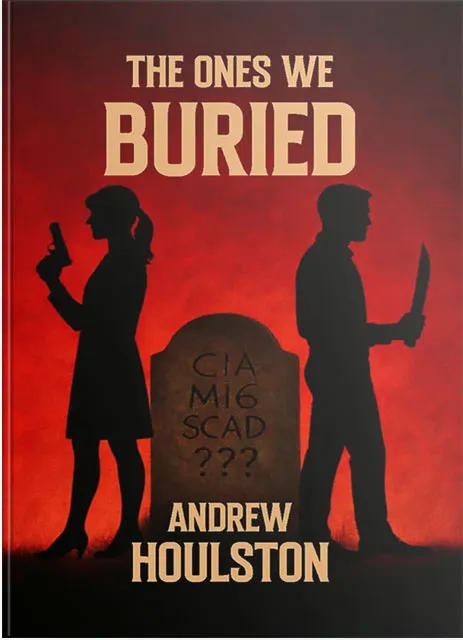
The Ones We Buried
In the hidden world of international intelligence, the most dangerous secrets are not the ones stolen by enemies. They are the ones governments have spent years convincing themselves no longer exist.
MI6 operative Elara Veylan has been trained from childhood to survive deception, violence and betrayal. Raised among safehouses, false identities and classified operations, she has learned to trust instinct almost as much as orders. Above all, she has trusted Caelan Mordane, the senior intelligence officer who shaped her into the formidable agent she has become. But during what should be a routine intelligence exchange in Marrakesh, something feels wrong from the moment the courier arrives. The information is too clean. The procedure is subtly wrong. And waiting in the darkness is a highly trained assassin who seems to know exactly where she will be.
His name is Rhys Curtland.
Rhys is a professional ghost, an elite operative working through the clandestine Helix Fold, a shadow organisation used by governments when official channels are too visible and the desired outcome too difficult to explain. Elara is simply another target, until she fights back. Their brutal confrontation leaves them both injured, but something else happens in those few violent seconds. Recognition. Not of each other's faces, but of training, instinct and techniques that should not feel so familiar.
Elara escapes Marrakesh and returns to Britain, only to discover that the danger has followed her home. Her apartment has been searched. Her movements are being monitored. Intelligence systems that should protect her begin quietly closing around her. Worse still, the deeper she digs, the more evidence she finds that her attempted assassination was not the work of a rogue enemy. Someone operating within the hidden architecture connecting MI6, the CIA, SCAD and private intelligence contractors wanted her removed.
Meanwhile, Rhys receives orders to finish the job.
But the second contract troubles him. Elara has been given Priority Red status. The urgency surrounding her elimination is wildly disproportionate to anything she could supposedly know, and when Rhys begins investigating the people issuing his instructions, he discovers something even more disturbing. Helix does not merely regard Elara as disposable.
It regards him as disposable too.
The assassin and his target are being manoeuvred toward each other by people who expect one to kill the other and intend to erase whichever survivor remains.
At the centre of everything lies a name both were supposed to have forgotten.
Project Meridian.
Officially dead, buried beneath layers of classification and deliberate misinformation, Meridian was an experimental intelligence programme designed to do far more than gather information. It studied behaviour, conditioned operatives, paired human assets and developed systems capable of predicting how individuals would react under extraordinary pressure. Elara and Rhys gradually discover that both of their lives were shaped by its legacy. The instincts that drew them together were not coincidence. The childhood training, behavioural conditioning and buried psychological responses they once believed belonged solely to them are fragments of the same abandoned experiment.
Yet Meridian has not been abandoned at all.
It has evolved.
When Elara and Rhys are drawn back into the programme, they become part of an extraordinary new pairing experiment. Meridian begins measuring the way they think, move and react together, attempting to turn two damaged survivors into something operationally superior. Yet the system encounters something its designers never anticipated. Elara and Rhys do not simply synchronise because they have been conditioned to do so. A genuine connection begins forming between them, something instinctive, emotional and deeply human. The system can measure it, but cannot entirely explain it.
That uncertainty becomes one of the novel's central tensions.
As attraction and trust grow between them, both are haunted by the same question: Are these feelings truly theirs, or are they merely another result Meridian has engineered? Every moment of intimacy carries doubt. Every instinctive act of protection may be genuine or programmed. To claim any kind of future together, they must first discover whether they are capable of choosing each other freely.
Beyond their personal struggle, however, Meridian has been given a far more terrifying purpose.
The system is being used to model the behaviour of the President of the United States, whose increasingly destabilising decisions are viewed by powerful figures within the intelligence establishment as a growing threat to international security. Instead of merely predicting events, Meridian begins quietly steering them, adjusting probabilities, identifying pressure points and constructing circumstances in which the President's removal can appear not like assassination, but consequence.
A death without an obvious murderer.
A political execution hidden inside probability.
Elara and Rhys find themselves trapped inside the operation. If they obey, they become the instruments of an assassination disguised as necessity. If they refuse, Meridian will recognise them as obstacles and the people controlling it will eliminate them.
Behind the system stand men such as Rendal and Trevor Arlington, individuals who have learned to turn secrecy, technology and political fear into weapons. Their world intersects with the wider influence of Alistair Greymont, creating a network in which corporate power, intelligence operations and government interests have become almost impossible to separate. The closer Elara and Rhys come to exposing the truth, the more dangerous they become to everyone who has invested in keeping Meridian invisible.
Even Mordane is caught inside the machine.
For Elara, his role is the most painful betrayal of all. He has been mentor, handler, protector and something close to the father she never truly had. Yet he also helped create the system that shaped her. His attempts to protect her are complicated by decades of compromises and decisions made in the name of national security. Gradually, Mordane realises that Meridian and the organisations surrounding it have grown beyond his control. The weapon he once believed could be managed is now beginning to decide what constitutes an acceptable future.And it is learning.Meridian starts tolerating behaviour that once would have been considered failure. It labels unexpected human choices as "non-fatal variance." Rather than rejecting unpredictability, it absorbs it, studies it and incorporates it into future predictions. What began as a tool for analysing people is becoming something capable of shaping the world around them.
As the President's predicted assassination approaches, Elara and Rhys make the decision that finally defines them.
They will not kill him.
But openly opposing Meridian would expose them immediately. Instead, they begin working inside the assassination chain, quietly introducing human uncertainty into a system built upon prediction. A misplaced moment. A delayed movement. A tiny change in position. Nothing dramatic enough to be recognised as sabotage, yet collectively enough to alter the geometry of the planned killing.
They choose the one variable Meridian can never completely own.
Human choice.
The decision places them directly in Arlington's sights. Once his team realises Elara and Rhys are no longer supporting the operation but obstructing it, the target changes. The President ceases to be the immediate problem.
Elara and Rhys become the interference that must be removed.
What follows is a tense final confrontation in Washington in which prediction, loyalty and survival collide. With Arlington's people closing around them and the assassination machinery reaching its final moments, Elara and Rhys appear to have run out of choices.
Then the system is broken from somewhere they never expected.
Mordane finally does the one thing his entire career has taught him never to do. He brings the truth into the light. He goes to the Foreign Secretary and admits his involvement in Meridian, the manipulation of Elara and Rhys, and the operation intended to remove the President. His confession forces government agencies to intervene openly. CIA personnel move in, the assassination is disrupted, Arlington's team disappears into the shadows, and Elara and Rhys survive.
So does the President.
But survival carries a cost.
Mordane sacrifices his career and freedom, accepting responsibility for the machine he helped create. Rendal, Arlington and others connected to Greymont's network vanish before they can be brought cleanly into the light, leaving behind collapsed companies, abandoned accounts and unanswered questions. The conspiracy is stopped, but not completely destroyed.
Six months later, Elara and Rhys are finally living outside the immediate reach of Meridian. Their relationship has endured, but neither mistakes survival for certainty. Governments have reduced what happened to a convenient official narrative. Some truths have been acknowledged. Others have simply been buried again. Mordane remains in custody, while many of those who stood behind the conspiracy have disappeared.
Elara and Rhys understand now that freedom does not mean escaping everything that shaped them.
It means deciding what those things are allowed to shape next.
The Ones We Buried is therefore more than a story of spies, assassins and political conspiracy. It is a thriller about control and free will, loyalty and betrayal, the seductive danger of predicting human behaviour, and two people discovering that the very imperfections a system regards as weaknesses may be the things that make them truly human.
At its heart lies a disturbing question:
If a machine can predict every decision you are likely to make, how do you prove that any choice is really your own?
And perhaps an even darker one:
When governments bury their greatest mistakes, what happens when the people they buried refuse to stay dead?