
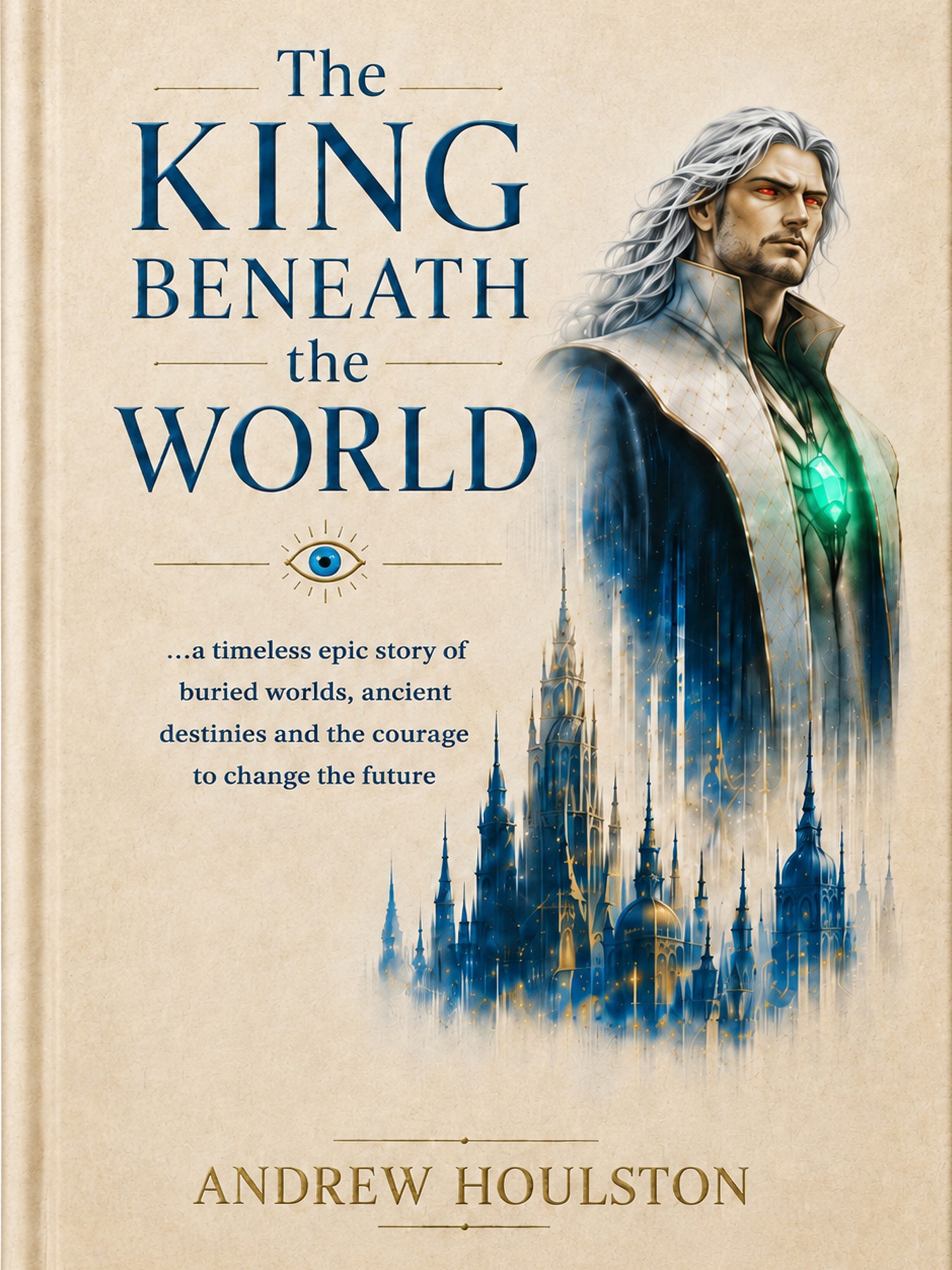
The King Beneath the World
Spoiler Alert: This summary reveals plot details that some readers may prefer not to know in advance.
For two thousand years, the Patronese have lived beneath the surface of Pagalan.
Driven underground by the catastrophic war with the Verentians, they escaped a world poisoned by fire, radiation and nuclear winter, retreating into the vast subterranean cities of Denesthear. There, hidden beneath mountains and ancient stone, they survived. Generations were born who never felt rain upon their faces, never walked beneath an open sky and knew the surface only through history, legend and the distant images returned by ancient observation systems.But Pagalan is healing.The poisoned skies are clearing. Rivers once locked beneath ice flow again. Forests and grasslands are slowly returning to continents that had seemed dead forever. After twenty centuries of darkness, the world above is beginning to breathe.
And deep beneath it, King Mandrake Martelismore I begins to ask a dangerous question.
If the surface can sustain life again, why should the Patronese remain buried?
Mandrake is young, thoughtful and increasingly troubled by the civilisation he has inherited. The underground cities are extraordinary achievements, sustained by ancient technology and the mysterious resonance systems that have protected the Patronese for centuries. Yet what began as sanctuary has slowly become something else. Their refuge has hardened into tradition, their caution into fear, and their ordered society into a rigid hierarchy where the High Orders enjoy privilege while countless Low Order citizens labour in the forgotten depths to keep Tramstell alive.To Mandrake, survival is no longer enough.He wants his people to reclaim the world above.His vision places him immediately at odds with powerful members of his own Council, particularly the formidable Yamanie Vorchester, who sees the underground civilisation not as a prison but as the perfected form of Patronese society. Beneath the earth, resources can be controlled, labour organised and every level of society kept within a carefully maintained order. A return to the surface would mean expansion, uncertainty and freedom, all things that threaten the system from which the ruling elite derive their influence.
Caught between competing loyalties is Gideon Soulestor, a councillor whose motives are far more difficult to read. At times he supports the rigid structures defended by Yamanie. At others, he questions the assumptions upon which those structures have been built. As alliances shift within the Council, Mandrake begins to realise that the battle over the future of his people may prove every bit as dangerous as the world waiting above them.The tensions are not confined to the chambers of power.
Far below Tramstell’s gleaming upper levels, Low Order workers live in cramped districts and maintain the ageing systems upon which everyone depends. Among them is Relven Darsk, a working man with a wife and young children who has little interest in politics but knows the truth that many above him prefer not to acknowledge: if those in the lower districts stop working, Tramstell stops breathing.
Discontent is growing.
Whispers become meetings. Symbols begin appearing on walls. Old resentments rise through the city’s veins as ordinary Patronese question why the civilisation they keep alive offers them so little in return. Mandrake attempts reform, opening channels through which the unheard may finally speak, but every attempt to loosen centuries of inequality threatens those who have benefited from it.Then something older awakens.The ancient portal gates buried within and beyond Denesthear begin to respond again. These are remnants of powers stretching back through Patronese history to the mysterious Benefactors, a civilisation whose technology was already ancient when the Patronese first encountered it. The gates do not behave like simple machines. They seem to recognise bloodlines, remember those who came before and respond to forces no living scholar fully understands.
So too do the immense chronometric automatons, the black obelisks marked with the glowing blue lidless eye that have guarded Denesthear's seas for centuries. They have kept outsiders away by disrupting currents, confusing navigation and turning the waters surrounding the Patronese homeland into a place of storms, wrecks and terrifying legend.
Mandrake once regarded them as guardians.
Increasingly, he wonders whether they are also jailers.
As Commander Borliac Moorlike investigates their capabilities, he discovers something deeply unsettling. The automatons may be capable of far more than defence. They can move. They can respond. Perhaps they can even carry the Patronese beyond the boundaries that have confined them for generations.
But commanding an ancient intelligence and being obeyed by it are not necessarily the same thing.
While Mandrake wrestles with the fate of an entire civilisation, his private world changes in a way no political calculation could have prepared him for.
His wife, Tabatha, is pregnant.
At first the news brings something rare into Mandrake's life: uncomplicated joy. Amid Council disputes, unrest and the gathering mysteries of the gates, the prospect of becoming a father gives him something personal to protect and a future that is more than an abstraction.Yet even before the child is born, strange things begin to happen.Tabatha senses patterns and directions she cannot explain. Diagnostic systems react unexpectedly. Ancient resonance appears to recognise the unborn child. Records hidden in the oldest layers of Patronese history speak of other children who responded when the gates stirred, of inherited connections passed through blood and memory, and of powers that were never entirely understood.The child growing within Tabatha is listening.And something is listening back.Suddenly the question of succession becomes something far greater than royal inheritance.For Mandrake, the awakening gates, the ancient green gem carried through generations from the lost world of Yath Varnel, and the extraordinary sensitivity of his unborn son begin to converge. Forgotten histories lead back through the Martelismore bloodline to Olivier Martelismore, to the first Patronese settlers, and ultimately to decisions made thousands of years earlier by people who could never have imagined what their descendants would become.
The past is no longer history.
It is reaching forward.
Mandrake is forced to confront the ruins of the old conflict, the road toward Verenteer and the buried truth of a war whose consequences still govern Patronese life after two millennia. What he discovers challenges the comfortable version of history preserved by those who survived it. The divisions between High and Low Order, the isolation of Denesthear, the gates, the automatons and even the authority of the Martelismore crown are revealed not as separate problems, but as pieces of a legacy that has been allowed to harden for centuries.At the centre of everything stands the king himself.Mandrake begins the story believing that kingship means choosing the correct future for his people. Gradually, he discovers something far more difficult. Leadership is not simply the right to decide. It is the willingness to listen to people whom power has taught others to ignore. It is knowing when traditions protect society and when they merely protect those who benefit from them. It is recognising that fear can disguise itself as wisdom, and that a civilisation can survive for so long that it forgets what survival was meant to preserve.Then his son is born.For a brief time, amid the ancient machinery and political unrest, the great questions of Pagalan become wonderfully small. Mandrake becomes simply a father holding his child. Tabatha becomes a mother rather than a queen. Their son is not yet an heir, a bloodline, a key or a prophecy.He is simply theirs.But history does not intend to leave him that way.The child's connection to the resonance grows increasingly significant, and Mandrake realises that the forces gathering around his family may eventually place his son in terrible danger. The ancient gates move toward another awakening. A powerful sword connected to the bloodline emerges as more than a royal artefact. The great obelisks begin behaving in ways that suggest their long watch has entered a new phase.
Mandrake is faced with the cruelest conflict of his reign.
The king in him must consider the future of his people.
The father in him wants only to save his child.
Those two duties can no longer be reconciled.
What follows becomes the hidden foundation of everything that will one day shape the life of Morganuke Beldere, the mysterious silver-haired, red-eyed young man raised far away on Banton Island with no understanding of the extraordinary history carried in his blood.
The sword.
The green gem.
The obelisks.
The portal gates.
The Wise One.
The lost kingdom beneath Denesthear.
The strange dreams and powers that will one day awaken within Morganuke.
All have roots here.
Yet The King Beneath the World is far more than an explanation of mysteries from The Pagalan Chronicles. It is the story of the people who lived those mysteries before they became legend.
It is the story of a king trying to lead a civilisation out of darkness while discovering that the greatest darkness may lie not in the caverns surrounding him, but in fear, inequality and the refusal to change.
It is the story of a people who survived the destruction of their world only to discover that survival itself can become another form of captivity.
It is the story of ancient machines that remember more than their creators understand, gates that answer to blood, forgotten powers stirring beneath stone and a wounded planet quietly calling its lost children home.
Above all, it is the story of Mandrake Martelismore, a king who begins by dreaming of leading his people back beneath the open sky and ultimately discovers that the greatest decision of his life may have nothing to do with crowns, councils or kingdoms.
It may simply be the decision of a father determined to give his child a future.
Before Morganuke searched for his roots, someone had to bury them.
The King Beneath the World reveals why.