
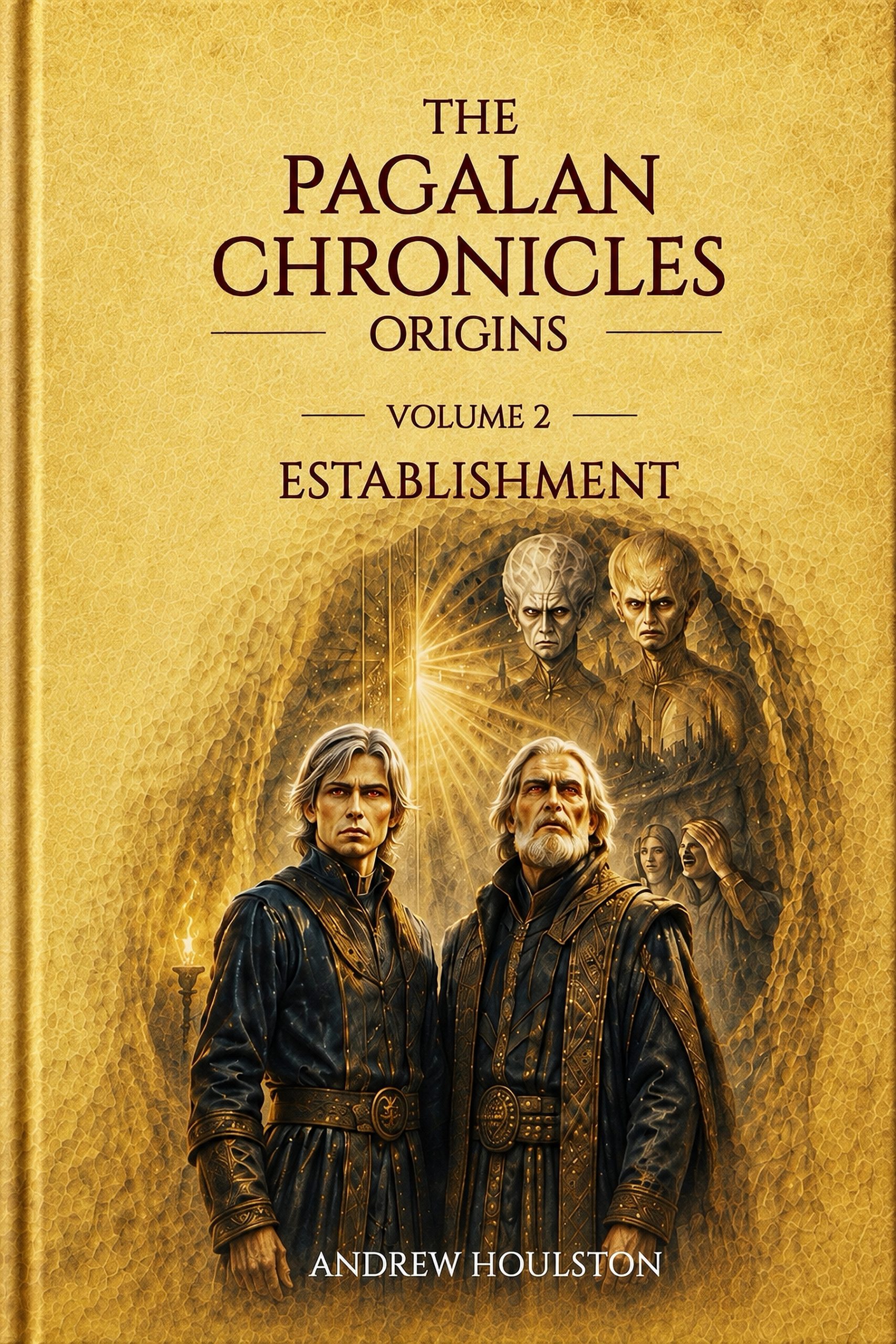
The Pagalan Chronicles Origins – Volume 2
Establishment
Spoiler Alert: This summary reveals plot details that some readers may prefer not to know in advance.
Five hundred years had passed since the Patronese fled their dying world and arrived upon Pagalan.
The frightened refugees who had once emerged from the sea beneath an alien sky were gone. Their descendants had inherited something far greater.
They had built a civilisation.
At the centre of it stood Tramstell, a magnificent city of ordered avenues, crystalline archives and technologies inherited from the mysterious Benefactors. Elsewhere across Denesthear, settlements had grown into cities. Trade had developed. Borders had stabilised. The desperate struggle for survival that had defined the first years on Pagalan belonged to history.
The Patronese had become established.
But survival had created new dangers.
The differences first noticed among the resonant children of the early settlement had hardened over the centuries into a social order. Those whose bloodlines possessed the strongest connection to the ancient gates and resonance systems became known as the High Order. Those whose abilities were weaker, or absent altogether, became the Low Order.
What had begun as distinction had become hierarchy.
What had become hierarchy was slowly becoming division.
And beneath Tramstell, something ancient had begun to awaken.
At the heart of Establishment stood Jason Telismore, a twenty-one-year-old archivist descended from two of the most important bloodlines in Patronese history.
The names Telismore and Camberlain carried enormous weight.
Jason felt every measure of it.
Where others of his age enjoyed the ordered prosperity of Tramstell, Jason preferred the stillness of the Archive Centre. He was quiet, socially awkward and far more comfortable among memory-stones and records than among crowds. The past asked nothing of him except that he listen.
And Jason listened extraordinarily well.
He studied the first arrival.
He watched preserved images of Nigel Telismore and Samir Camberlain.
He followed the growth of Denesthear, the rise of Sostrem and the uneasy relationships that had developed between the Patronese and the indigenous peoples of Pagalan.
But the deeper he explored, the less comfortable that history became.
The archives revealed the beginnings of the High and Low Order division.
Jason discovered that it had not simply emerged naturally.
It had been encouraged.
Protected.
Justified.
Successive generations had convinced themselves that those with stronger resonance represented something purer and more valuable. Access to knowledge, influence and the ancient technologies increasingly followed bloodline rather than merit.
To Jason, the history no longer looked like the orderly progress celebrated by the Council.
It looked like the beginning of a fracture.
Then the archives spoke to him.
Deep within the older vaults, a resonance console responded in a way no ordinary machine should have done. Light formed ancient patterns. The buried technology seemed to recognise Jason’s presence.
Then he heard words.
Blood remembers.
Jason could not tell whether he had heard the preserved voices of his ancestors, some intelligence embedded within the Benefactor technology, or something stranger.
But one thing became certain.
The ancient systems were waking.
And they knew who he was.
Far beyond Tramstell, another Patronese was already moving towards the same mystery.
Commander Gideon Frampton led a covert expedition beyond the established borders of Denesthear.
For centuries, the Patronese had restricted their contact with the wider world. Their ancestors had arrived promising that they would not become conquerors, and the disastrous near-conflicts of the early settlement had taught them how easily technological superiority could become domination.
The main continent therefore remained largely beyond Patronese influence.
But somewhere in those distant lands another ancient gate was believed to exist.
The Council wanted it found.
Gideon was ordered to lead the expedition.
He did so reluctantly.
He knew what could happen when Patronese curiosity crossed the boundaries of another civilisation. His team travelled disguised as ordinary wanderers, using horses, carts and traditional clothing rather than openly displaying their advanced technology.
They were not supposed to be seen.
They were not supposed to interfere.
And above all, they were not supposed to repeat the mistakes of the past.
The precautions soon proved necessary.
The lands beyond Denesthear were not empty.
Gideon’s expedition encountered indigenous hunters and communities whose lives had developed independently of Patronese influence. He understood immediately that discovery could ignite fear on both sides.
The Patronese possessed aircraft, energy weapons and technologies inherited from an ancient civilisation.
The people around them possessed spears, bows and their own traditions.
One frightened encounter could become a massacre.
Gideon therefore chose restraint.
It was a decision that increasingly placed him at odds with those in Tramstell who believed Patronese superiority gave them the right to control whatever they discovered.
Meanwhile, Jason’s investigations were drawing him towards the same conflict from another direction.
His father, Maron Telismore, sat upon the governing Council.
Maron represented much that Jason distrusted about the established High Order. He believed discipline was essential to survival and saw the distinction between High and Low Order as part of the structure that had preserved Patronese civilisation.
To Maron, order prevented collapse.
To Jason, that same order increasingly looked like a cage.
Their relationship became a deeply personal expression of the greater struggle taking place across Tramstell.
Jason loved and respected his father.
He also feared becoming him.
Council debates revealed how divided the ruling elite had become.
Seliora Veynn favoured stricter control.
Orric Malvek warned that oppression of the Low Orders would ultimately destroy the unity the Council claimed to defend.
Thyra Camberlain-Dorneth argued that the gates were not possessions to be commanded but mysteries that demanded caution.
Daelith Corranor saw something else entirely.
Power.
If the gates were awakening, Daelith believed the High Order had to control them before anyone else could.
And then there was Veyra Solenne.
Young, intelligent and increasingly unwilling to accept the assumptions of those around her, Veyra challenged the idea that Patronese civilisation could be preserved through division.
Jason found himself drawn to her argument.
Then, unexpectedly, he found himself trusting her.
Their relationship became one of the central forces within the story.
Jason had spent much of his life emotionally isolated, more comfortable with dead voices than living ones. Veyra was one of the first people who truly listened to him without dismissing his fears or treating his unusual connection to the resonance as something to be controlled.
Together, they began searching the sealed archives.
What they found transformed suspicion into certainty.
The ancient gates had not merely been abandoned.
They had been sealed.
More than two hundred years earlier, Patronese expeditions had passed through them and disappeared.
Some records contained no confirmation of arrival.
No return signal.
No explanation.
People had simply stepped through the light and vanished.
Other fragments suggested something even more disturbing.
There had been survivors.
But what had returned might not have been entirely as it had left.
The Council had buried the records.
Jason and Veyra began to understand why.
If the truth became public, the consequences would have reached far beyond curiosity about the gates.
The Low Order would have demanded to know why generations had been denied access to information that affected all Patronese.
The indigenous peoples would have questioned the High Order’s claim that the gates belonged uniquely to them.
And the High Order itself would have been forced to confront the possibility that centuries of authority rested partly upon deliberately suppressed history.
For Jason, the conclusion became unavoidable.
The Council’s greatest concern was not always protecting the people.
Sometimes it was protecting itself.
He and Veyra made a dangerous pact.
They would continue investigating.
They would reveal nothing until they had enough proof that the Council could not simply erase it.
Veyra would continue playing the role of councillor.
Jason would remain the apparently dutiful son of Maron Telismore.
Behind that appearance, they would search for the truth.
Events beyond Tramstell soon made secrecy far more difficult.
Gideon Frampton’s expedition located the ancient gate in the highlands.
It was not dead.
The resonance within it was stirring.
And the surrounding peoples knew far more about the structure than Patronese arrogance had allowed anyone to expect.
Tension grew around the expedition.
Local tribes watched the intruders.
The Patronese watched the tribes.
Every movement became open to misinterpretation.
The gate itself seemed almost to amplify the uncertainty.
Then communication became possible in a way no one had anticipated.
The stones carried voices.
Jason’s resonance connection allowed information to pass through systems that should not have functioned. Distance ceased to be an absolute barrier.
The ancient network was not simply awakening physically.
It was beginning to connect people.
Jason realised that Gideon was in danger.
The Council had become increasingly suspicious of what the expedition might discover, and there were powerful figures who would rather control the truth than allow it to return freely to Tramstell.
Jason and Veyra needed someone capable of reaching Gideon without official attention.
They found him in the least respectable corner of Patronese society.
Aric Dane.
Aric was a Low Order smuggler, pilot and survivor who inhabited the shadowed world beneath Tramstell’s immaculate appearance. His ship, the Raven’s Wing, was scarred, temperamental and equipped with a cloaking system that worked only when it felt inclined to cooperate.
To Jason, trusting a smuggler seemed almost absurd.
To Veyra, it was precisely the point.
The respectable institutions of Tramstell were part of the problem.
If they wanted to move outside the Council’s reach, they needed someone accustomed to living beyond its rules.
Aric accepted the mission.
The Raven’s Wing carried warnings north.
But the highlands were becoming increasingly dangerous.
Storms battered the aircraft.
The cloaking system faltered.
Tribal warriors watched the skies.
The gate pulsed beneath the mountains.
And the Council’s agents began tightening their grip around everyone involved.
Jason himself eventually left Tramstell with Veyra.
It was a profound step for the young archivist.
The man who had spent his life hiding among records was suddenly travelling towards the very history he had spent years studying.
The journey was neither clean nor heroic.
The Raven’s Wing shook violently through dangerous skies. Systems failed. Veyra was injured during severe turbulence. Jason found himself confronted with a responsibility very different from reading about the sacrifices of his ancestors.
Real people could die because of decisions he made.
Aric warned him of precisely that.
Leadership did not mean possessing the right bloodline.
It meant carrying the consequences when other people paid for your choices.
Jason began to change.
The frightened, socially uncertain archivist was still there, but another part of him was emerging.
He became willing to act.
To disobey.
To place himself in danger.
And eventually, to confront those who believed his surname guaranteed his obedience.
The situation around the gate deteriorated.
Patronese forces and tribal groups moved closer to violence. Suspicion became confrontation. The ancient structure, rather than remaining a silent prize between them, continued reacting to people and events in ways neither side completely understood.
Beneath the surrounding mountains, further discoveries deepened the mystery.
Ancient passages.
Buried systems.
Forgotten chambers.
Evidence that the Benefactor presence on Pagalan had extended far beyond the structures the Patronese had already identified.
And something else.
Something that suggested the ancient architects of the gates had never viewed Pagalan as merely a place to inhabit.
The world might have been part of a much larger design.
Jason, Gideon and Veyra increasingly found themselves caught between three threats.
The tribes, who understandably feared Patronese intrusion.
The ancient technology itself, whose purpose remained uncertain.
And their own Council.
The last of these gradually became the most dangerous.
At the centre of that danger stood Commander Hector Chalsmore.
Hector believed in power stripped of hesitation.
To him, compassion bred weakness and uncertainty invited rebellion. He considered Gideon’s caution dangerous, Veyra’s independence subversive and Jason’s growing refusal to obey particularly threatening.
Jason was young.
But Hector understood something many councillors had overlooked.
The boy carried hope.
And hope could overturn systems built upon fear.
Hector was ordered to bring Jason back.
The confrontation transformed the struggle.
Jason, Veyra and Gideon were captured.
Their journey back towards Tramstell took place in chains.
Yet captivity brought the three closer together.
Gideon, who had relied throughout his life upon strength and discipline, was forced to admit that brute force could not solve every problem.
Veyra understood political deception.
Jason understood the resonance.
Together they formed a pact.
They would survive.
They would escape the narrative being constructed around them.
And they would prevent the gate from becoming another weapon in the High Order’s struggle to preserve its dominance.
The Council itself was beginning to fracture.
Old loyalties became unstable.
Even Maron Telismore could no longer remain untouched by what was happening.
For much of Jason’s life, father and son had stood on opposite sides of an invisible wall.
Maron believed obedience protected civilisation.
Jason believed truth mattered more.
Yet as Daelith Corranor’s ambition became increasingly obvious and the consequences of the Council’s secrecy grew harder to defend, Maron was forced to reconsider the system he had spent years protecting.
The conflict stopped being simply Jason against his father.
Both men began to recognise that something larger was using their disagreement.
Then came the struggle for the gate.
Hector’s desire for control hardened into open brutality.
The green gem connected with the ancient technology became a focus of power.
The tribes resisted.
Patronese soldiers divided in loyalty.
Blood spread across the snow.
Commander Smarland challenged Hector’s authority.
Hector answered by killing him.
The act shattered whatever remained of legitimate command.
Hector no longer pretended that he served law or Council.
He served power.
And the ancient resonance seemed to respond dangerously to the violence around him.
Jason realised that the gem was not simply an object to be possessed.
Like the gates, it reacted.
Perhaps it judged.
Perhaps it influenced.
Whatever the truth, no one who sought to dominate the Benefactor systems could safely assume that those systems were passive machines.
The confrontation at the gate became catastrophic.
Patronese and tribal forces fought around something neither truly controlled.
Hector’s ambition finally carried him beyond the boundary everyone else had feared to cross.
Jason followed.
He passed through the gate.
And for the first time, one of the central mysteries inherited from the earliest Patronese settlers opened before him.
The place beyond was unlike Pagalan.
It was unmistakably the domain of the Benefactors.
Smooth white structures stretched beyond ordinary understanding. Machines rested in perfect silence. Architecture, energy and intelligence appeared to merge into a system created by beings whose capabilities had surpassed even Patronese science.
Jason had spent his life studying their remains.
Now he stood inside their world.
What he learned changed his understanding of everything.
The Benefactor legacy had not been created merely to provide weapons.
Nor had Pagalan simply been gifted a collection of miraculous machines.
The ancient technology contained systems capable of construction, protection and control on an enormous scale.
Machines could carve through stone.
Energy fields could divide territories or prevent armies from crossing without slaughter.
Ancient networks could rebuild routes and stabilise damaged regions.
The same technology that ambitious men saw as a means of domination could instead be used to prevent war.
Jason also came to suspect something more profound.
The Benefactors had not necessarily created their systems to save Pagalan.
They might have been testing it.
The gates were not merely doors.
They might have been trials.
Resonance was not merely a source of power
.It might have been a measure of how those encountering that power chose to use it.
Jason had entered searching for technology.
He found a moral question.
What did an advanced civilisation do when it gained the ability to control almost everything?
The history of the Patronese already contained one answer.
They created hierarchy.
They hid knowledge.
They convinced themselves that superior ability justified superior authority.
Jason wanted another.
Hector did not survive his encounter with what lay beyond.
Jason did.
When he returned through the gate carrying the green gem, soldiers stared at him as if someone had returned from the dead.
In many ways, someone had.
The archivist who came back was no longer content merely to uncover history.
He intended to change what came next.
Yet Jason refused to simply hand the Benefactor discoveries to the Council.
He had seen too much.
In the wrong hands, even defensive technology could become an instrument of imprisonment.
An invisible barrier capable of stopping an army could also be used to trap an entire population.
A machine capable of rebuilding cities could just as easily give one faction overwhelming control over every other.
Technology did not contain morality.
The person using it supplied that.
Jason returned to Veyra and Gideon with a new possibility.
They did not need to destroy the tribes.
They did not need to arm the High Order with ever more powerful weapons.
They could rebuild the ancient passageways.
Create defensive barriers.
Stabilise the regions between peoples.
Use technology to prevent slaughter rather than perfect it.
For the first time, an alternative to the cycle of fear seemed possible.
Jason also returned to his father.
The reunion between Jason and Maron carried all the weight of their fractured relationship.
The Council believed Jason dead.
Maron had been forced to confront the possibility that the son whose defiance had frustrated him might never return.
Now Jason stood before him carrying knowledge that could transform Patronese civilisation.
The reconciliation was neither simple nor complete.
Too much had happened.
Too many secrets remained.
But something changed.
Maron listened.
Father and son finally began to see one another not merely as rebel and authority, but as two men frightened by different versions of the same future.
Maron understood that the technology Jason had discovered could destroy Pagalan if controlled by people like Daelith.
Jason understood that simply exposing every secret without considering the consequences could be equally dangerous.
Veyra helped bridge the space between them.
A fragile alliance formed.
The gate’s resonance had also begun reaching beneath Tramstell itself.
Ancient foundation nodes responded.
Forgotten systems pulsed within the city’s depths.
The capital that prided itself upon perfect order was built over mechanisms older than the civilisation occupying it.
Something had begun travelling through those veins.
The Council could no longer plausibly claim that the awakening was confined to a distant mountain.
The gates were connected.
Tramstell was part of the network.
Perhaps it always had been.
Jason and his allies faced a final choice.
They could retreat.
Seal the information.
Allow the city to return to the illusion of stability.
Or they could go back.
They chose to return to the highlands.
Maron authorised a covert expedition disguised as an ordinary survey mission. Daelith, already suspicious, attempted to place his own observer among them.
The political game was far from finished.
Neither was the mystery.
Gideon’s surviving expedition members re-joined him, scarred by everything they had endured but still willing to return.
The Raven’s Wing and the official transports once again pointed north.
Jason went with them.
So did Veyra.
So did Gideon.
Even Maron had moved far enough from his former certainty to understand that the truth could no longer simply be sealed behind another Council door.
And beneath the snow of the highlands, the ancient gate waited.
By the end of Establishment, the Patronese civilisation remained powerful.
Its cities still stood.
Tramstell still gleamed.
The High Order still governed.
The Low Order had not yet risen in open revolution.
To anyone looking only at the surface, the civilisation created by Jentry Camberlain and the first settlers appeared secure.
But Jason now knew better.
The fractures were already there.
The High and Low Orders were drifting further apart.
Council members had begun treating ancient technology as a route to political supremacy.
The indigenous peoples had learned that Patronese promises of non-interference could not always be trusted.
Benefactor systems were awakening after centuries of silence.
The gates remembered blood.
The stones carried voices.
And the historical truths upon which the High Order had built its authority were beginning to escape from the archives.
This was the deeper meaning of Establishment.
It was not merely the story of a civilisation that had established itself successfully upon Pagalan.
It was the story of what happened after success.
The first Patronese settlers had struggled against cold, hunger and an unknown world.
Their descendants faced a subtler danger.
Certainty.
They had grown comfortable enough to believe that their social order was natural.
Powerful enough to believe that their control was wisdom.
Advanced enough to believe that possession of technology proved the right to command it.
And isolated enough to forget the promise made by their ancestors when they first stepped onto Pagalan.
Jason Telismore became the challenge to that certainty.
He had inherited the bloodlines of those who helped create the Patronese order, yet he increasingly refused to accept that inheritance without question.
He began as a lonely archivist fascinated by ghosts.
He became a keeper of dangerous secrets.
Then a fugitive.
A prisoner.
A traveller through an ancient gate.
And finally someone who understood that the past was useful only if the living were willing to learn from it.
His greatest discovery was not a machine.
It was a choice.
The Benefactor technology could become a weapon or a shield.
The High Order could answer unrest with oppression or reform.
The gates could become instruments of conquest or bridges between peoples.
And inherited power could be preserved simply because it had always existed, or questioned before it poisoned everything built upon it.
Jason chose to question.
Veyra chose to stand beside him.
Gideon chose restraint over conquest.
Even Maron began to discover that preserving civilisation sometimes required challenging the very institutions created to protect it.
But the danger had not passed.
Far beneath the ordered streets of Tramstell, ancient resonance continued to move.
Across the distant highlands, the gate remained awake.
The Low Order had not forgotten generations of inequality.
And among those who still believed power belonged only to the people strong enough to seize it, the lessons of the crisis had not been learned.
The Patronese had successfully established themselves upon Pagalan.
Now came the far more difficult question.
Could the civilisation they had built survive what it had become?
The Pagalan Chronicles Origins Volume 2: Establishment carried the history of Pagalan beyond the optimism of the first settlement and into an age of secrets, political ambition and awakening ancient power. It revealed how the early distinction between resonant and non-resonant Patronese had evolved into the High and Low Order divide, how fear had transformed the gates from shared mysteries into controlled assets, and how the truth of the Benefactors had been buried whenever it threatened established authority.
At its centre remained Jason Telismore, a young man born into privilege who discovered that inheritance did not require obedience.
The first settlers had built Tramstell.
Their descendants had built an order around it.
Jason had begun to discover the cost.
Five centuries after the Patronese arrived on Pagalan, they no longer had to fight to establish their civilisation.
They had to fight to decide what kind of civilisation it would become.